


2026 Small Business Outlook: What Owners Should Expect This Year
When to Invest in Equipment and How to Finance It
At the start of 2026, many small business owners are asking the same questions. Is a slowdown coming? Should I hold onto cash? Is this the right year to invest in equipment, or is it better to wait?
Those concerns are understandable. The past several years have required constant adjustment in order to survive and thrive. From shifting interest rates to supply chain disruptions and rising operating costs, challenges abounded. The good news is that the outlook for 2026 is less about reacting to surprises and more about planning with clearer expectations.
This year is shaping up to reward businesses that make thoughtful, targeted decisions rather than rushing forward or pulling back entirely. Understanding the broader environment can help owners decide when to invest, how to structure financing, and where equipment upgrades make the most sense.
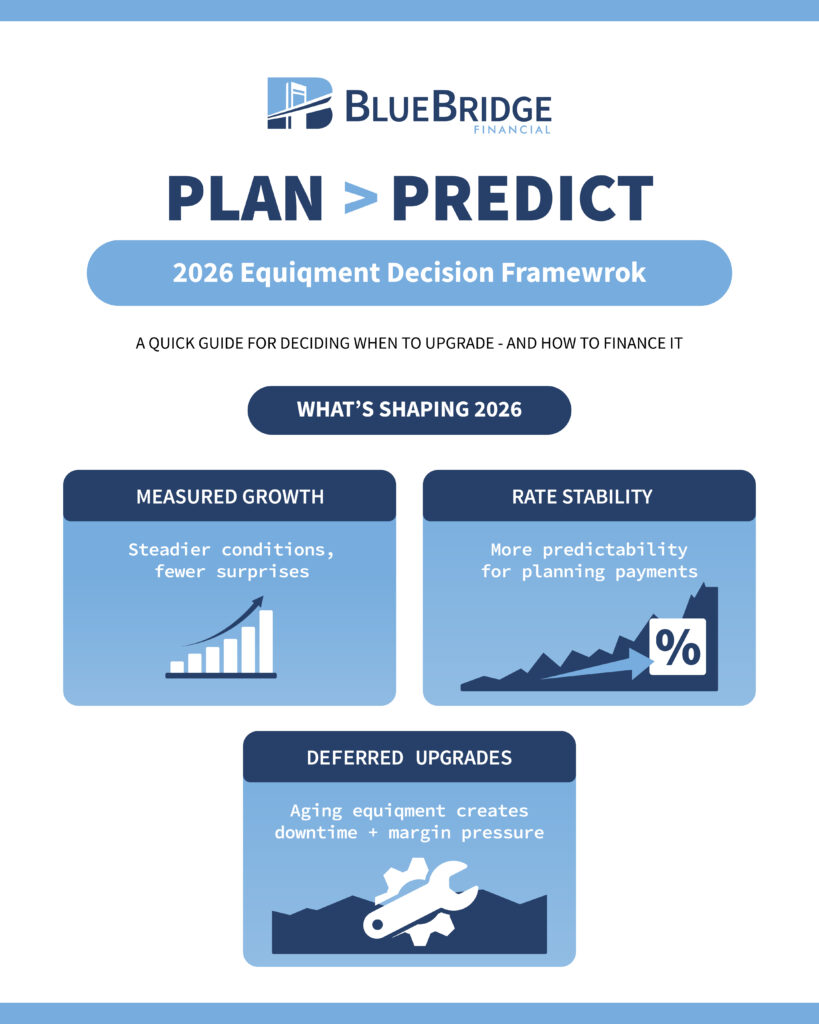
Measured Growth, Not a Pullback
The big picture for 2026 points toward continued economic growth, although at a slower and more measured pace than earlier in the decade. Most forecasts suggest expansion rather than a broad downturn, with fewer abrupt shifts than many businesses experienced in recent years.
That outlook is reflected in how business owners themselves are feeling. Recent surveys show that a large majority of small business owners remain cautiously optimistic heading into 2026, even as they navigate rising costs and ongoing labor challenges. Many expect revenue growth in the year ahead but are approaching decisions with discipline rather than urgency.
Labor markets are expected to cool modestly, particularly in consumer-facing sectors. At the same time, demand remains steady across many equipment-heavy industries such as construction, transportation, manufacturing, and specialty services. In these fields, productivity, uptime, and operational capacity continue to matter even when growth moderates.
Inflation pressures have eased compared to recent years, although costs related to labor, insurance, and compliance remain elevated in some sectors. For many owners, the challenge in 2026 is less about absorbing sudden shocks and more about managing margins carefully while maintaining service levels and reliability.
These small business economic trends 2026 reflect a shift toward steadier conditions rather than rapid expansion or contraction. For businesses with a clear understanding of their cost structure and demand cycles, this environment supports disciplined investment rather than across-the-board cutbacks.
Interest Rates in 2026: More Stability, Better Planning Conditions
For small business owners, the interest rate environment heading into 2026 is expected to feel more stable than what many experienced earlier in the decade.
While borrowing costs may adjust modestly over time, most outlooks point to rates remaining elevated compared to earlier periods. At the same time, volatility has eased, giving owners more clarity when planning equipment purchases and capital investments.
This 2026 interest rate forecast for small business loans points toward greater predictability, even as borrowing costs remain higher than earlier parts of the decade. What matters most for decision makers is not short-term rate movement, but predictability. When payments can be modeled accurately, businesses are better able to align financing with cash flow and make equipment decisions based on operational needs rather than market timing.
This is where understanding the fundamentals of equipment financing becomes important. Structuring terms, selecting fixed payments, and matching financing to asset life can provide confidence even when broader conditions remain uncertain. For owners reviewing options, Blue Bridge’s guide to equipment financing basics and its overview of equipment finance agreements offer helpful context.
In practical terms, the 2026 interest rate environment favors businesses that plan ahead and focus on structure rather than speculation.
Equipment Demand in 2026: Deferred Decisions Are Coming Due
One of the defining trends heading into 2026 is the growing need to address deferred equipment purchases.
Many businesses delayed upgrades during periods of uncertainty. As a result, aging fleets and outdated machinery are increasingly creating operational friction.
Equipment that is pushed beyond its ideal service window can lead to unplanned downtime, inconsistent performance, and scheduling challenges that ripple across the operation. For many owners, the issue is no longer whether equipment technically still works, but whether it supports reliable delivery, crew productivity, and customer expectations.
In 2026, reliability and uptime are becoming competitive advantages, especially in industries where missed deadlines or service interruptions carry real consequences. Businesses that address these issues proactively are often better positioned to protect margins, retain customers, and operate with confidence as demand stabilizes.
Taken together, these conditions shape 2026 equipment demand and growth forecasts, which are increasingly driven by operational necessity rather than expansion alone.
Cost-conscious owners are also evaluating alternatives to buying new. In many cases, financing used heavy equipment can provide a practical path to upgrading capacity while managing upfront cash requirements. When properly evaluated and financed, used equipment can deliver strong value without sacrificing operational reliability.
At the same time, technology-driven upgrades continue to shape demand in specialized operations. For manufacturers and precision-focused businesses, using additive manufacturing to upgrade your business can improve efficiency, shorten production timelines, and support new revenue opportunities even during periods of moderate growth.
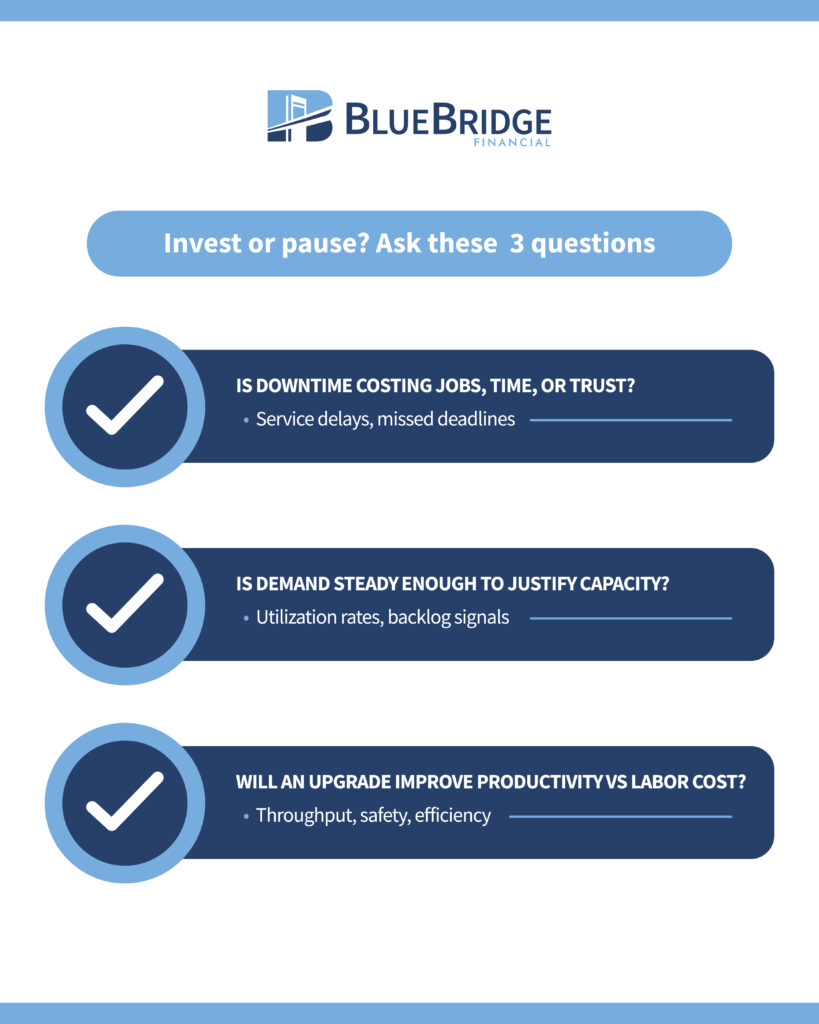
Invest or Pause: A Practical Decision Framework
Deciding whether to invest in equipment in 2026 does not come down to a simple yes or no. For most owners, the real question is when and how to move forward.
It may make sense to invest if equipment downtime is affecting service levels, if demand is steady or increasing, or if labor costs are rising faster than productivity. Upgrades that improve efficiency, safety, or throughput often deliver long-term operational benefits.
Capacity decisions are especially common in fleet-based businesses. Owners weighing whether they are ready to add a new unit to their commercial fleet should consider utilization rates, maintenance demands, and how additional capacity would translate into actual revenue.
In many cases, the decision is not about growth versus caution. It is about structuring investments so that they support the business without introducing unnecessary operational or financial strain.
How Financing Supports Smart Growth in 2026
In a year defined by steadier growth and improved predictability, financing plays a central role in helping businesses remain flexible.
Rather than tying up cash in large upfront purchases, many owners are using equipment financing to preserve liquidity while still investing in the tools their operations depend on. This approach helps maintain working capital for payroll, inventory, and unexpected expenses.
Asset-backed financing also allows payments to align more closely with how equipment generates revenue. When financing reflects real-world usage and cash flow patterns, businesses gain room to operate without overextending.
These equipment financing trends 2026 show a clear preference for flexibility, predictable payments, and financing structures that align with real-world equipment usage.
Working capital solutions can further support this flexibility, particularly during expansion periods or seasonal swings. Used thoughtfully, they allow businesses to respond to opportunities without compromising day-to-day operations.
Service-oriented businesses provide a clear example. For owners considering expanding an auto repair business, financing can support new bays, diagnostic equipment, or additional service lines while keeping cash available for staffing, training, and customer acquisition.
The goal is not aggressive leverage but thoughtful structure. A financing partner that understands equipment, industry dynamics, and cash flow realities can help owners make decisions that strengthen the business over time.
Planning Beats Prediction in 2026
The outlook for 2026 does not demand perfect forecasts. It rewards preparation.
Businesses that understand their equipment needs, cash flow cycles, and operational priorities are better positioned to move forward with confidence. Whether that means upgrading aging assets, adding capacity, or selectively investing in new technology, planning matters more than guessing where the economy might go next.
For owners navigating these decisions, the right conversation can make a meaningful difference. Blue Bridge works with businesses across equipment-heavy industries to help translate economic conditions into practical financing strategies.
If you are evaluating equipment purchases or planning upgrades in 2026, reach out to Blue Bridge to talk through your options or start a simple pre-qualification to explore financing that fits your business.